The problem with vocational testing in career counseling
for adolescents and young adults
I was an adolescent when I discovered that there were quizzes that promised to reveal my personality, my type, and even who I was destined to marry. It was thrilling to answer a few questions and quickly get to the holy grail: the revelation about who I truly was and what my future held!
As a career counselor specializing in adolescents and young adults, I worry that our field’s emphasis on “finding your passion" and "what you are good at” through vocational testing provides a similarly superficial promise of revealing “your type.”
This emphasis on identifying one’s individual tendencies to find a happy future is not devoid of sense. Like most people who developed and who apply vocational tests, I, too, am trained in psychology, more specifically adolescent development and psychology at the Master’s level. I concur that helping young people understand what makes them tick and giving them language to name what they may sense about themselves is part of our responsibility as supportive adults. In other words, it is not wrong to use and be excited about tools that can help young people understand themselves.
My concern is that when we put all our energy into uncovering young people’s interest, we encourage the false idea that the professional holy grail rests primarily inside one’s preferences. We seem to promise to the young person a world in which “if you love beauty and design, are good at math and at building things, you will likely be happy pursuing architecture.”
Wish we lived in a world that simple! Vocational testing can come across to young people as a simple answer to a process that is much more complex and dynamic.
Beyond our personal interests and tendencies there is a world to understand and consider. Factors external to our interests, passions and tendencies, play a powerful role in whether we have a career at all, or just a hobby.
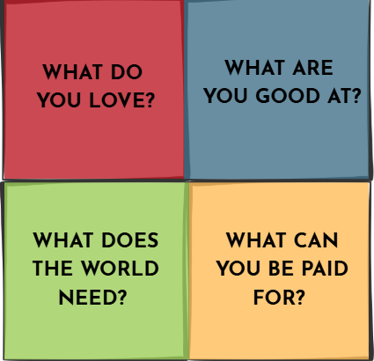
Early in my career as a counselor, I came across an image that was revealting. It was a square divided into four, each containing a question (see side image). On the left top and bottom, the questions were: “What do you love?” and “What are you good at?” I called these the “self” questions-the questions that psychologists and vocational testing prioritize.
But on the right side, top and bottom, were a set of other, equally important, questions: “What does the world need?” and “What will the world pay for?” I called these the “world” questions--the questions that social scientists (my other professional hat) prioritize.
I would later learn that these four questions were based on the Japanese concept of ikigai, which literally translates to “reason for being.” In ikigai, you have four circles, each with one of the questions above in their center, so that the center where the four circles meet becomes one’s ikigai, or purpose.
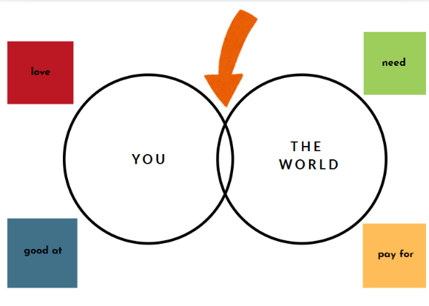
Similarly, in my work as a career counselor I offer young people tools to explore their answers to both the “self” questions (What do you love? What are you good at?) and the “world” questions (What does the world need? What will the world pay for?). A simple representation would the image on the right.
The “self questions” are easier to answer, of course. You can take vocational tests alone, you and your computer. They are fun, they are easy, often quick, and the results typically feel good because they make concrete what previously was probably an amorphous sensation, like “I’m good with numbers.”
But, that kind of insight should not be confused with finding what you are meant to do professionally. (I am not suggesting that there is a single answer to what we are meant to do professionally. But that needs its own post another day.)
What I am suggesting is that to move from nice ideas such as “I think I would be happy being an architect” to reality, we must investigate the world.
I suspect that a lot of career counseling focuses on the self (or on the you in the image) because helping young people uncover how the world of professions works, now and in the future, is a lot more work. It takes time and demands a great deal research, connections, and confidence. It demans that immerse ourselves in the very world we want to prepare our students for.
I would say that it is precisely because these skills are so challenging to teach that it is incumbent on us, supporting adults and career counseling professionals, to encourage and guide the development of these skills in young people.
What would that look like? Here I add a few suggestions, but the list is infinite in possibilities.
For example, let us help young people identify the professional networks that are already part of their lives and then teach them how to expand on that start.
Let us prepare young people to approach professionals they have never met before for an informational interview and conduct visits to previously unfamiliar work environments.
Let us teach them how to interpret job market data, and how that data might change depending on the region of a country or even different countries.
Let’s help them learn about what professions are on the rise, which are stagnant, and which ones are one their way out, using existing data and conversations with people who work in their fields of interest today.
Let us teach young people to ask questions about salary ranges without being intrusive, and to have the answers inform their ideas about the lifestyle they hope to lead as adults.
Let’s help them explore different definitions of success and challenge the simple idea that a high income equals happiness.
Let’s teach them how to find new professions they didn’t even know existed and ask people in these previously unknown professions how what they have studied helped them get there.
In other words, let’s help young people build the skills and confidence to get their hands dirty!
My high school students who went out into the world of work after learning some of these skills came back elated. When they were asked by their teachers to identify the experience they had found most valuable at the end of the semester, most said “getting out there and talking to professionals about what they do.” Many students said they didn’t realize they were capable of it, and once they did, they felt incredibly empowered.
Many young people are thirsty to discover the world of work and the options open to them in greater depth. Let’s meet their curiosity with real world tools that give them more than any vocational test ever could.
Julia Kirst, PhD
February 2026